Digital Parenting: How to Support and Reassure Parents?

Supporting and reassuring parents means clearly explaining how digital tools are used in the classroom, within a pedagogical framework controlled by the teacher. Educational tools, immediate feedback, and progress tracking strengthen learning, particularly in mathematics, while giving teachers more time to support students.
What is Digital Parenting?
Digital parenting refers to all the practices and support that help in accompany parents and their children in using digital tools. It concerns managing social media, learning good digital practices, and establishing a reassuring and educational framework in daily life.
Parents' Distrust of Digital Tools in Schools
Parents today express growing distrust toward the use of digital tools in schools, fearing excessive screen time or diminished learning.
A Common Confusion Between Educational Technology and Recreational Use
This concern, while understandable in a world saturated with digital solicitations, often stems from confusion between recreational or addictive uses of digital technology (social media, games, videos) and strictly pedagogical uses that are supervised and based on cognitive science.
It's important to distinguish between these two realities and provide families with factual information to inform the debate.
What Education Sciences Actually Say About Digital Technology
Current research in neuroscience and education sciences suggests that digital technology, when well-designed and thoughtfully integrated into classroom practice, can contribute positively to learning, particularly in mathematics.
The myth that screens are "inherently bad" for children doesn't hold up to the existing data.
It's not screens that are the problem, but the intention and framework in which they're used, thus often involving unregulated recreational use at home.
Digital Technology in Service of Demanding Pedagogy According to the OECD
The OECD report on the future of skills (PISA) shows that countries that integrate digital technology within demanding pedagogy achieve better results. They better prepare students capable of reasoning, understanding complex problems, and adapting to an increasingly digital professional world.
It's therefore not about "giving in" to the sirens of technology, but about using digital tools as instruments in service of demanding and effective pedagogy.
In other words, it's not about opposing screen to paper, but finding the right balance, one where students manipulate, reason, write, model... and also use the right technological tools for their education.
The Four Pillars of Learning According to Neuroscience
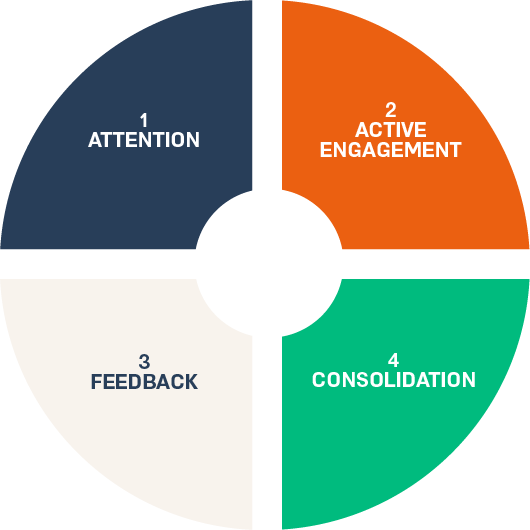
As neuroscientist Stanislas Dehaene reminds us, there are four pillars that are essential to any effective learning: attention, active engagement, feedback, and consolidation through repetition.
Math apps like myBlee don't replace teachers or human interactions in the classroom;
- They play a role comparable to that of textbooks when they first appeared in the early 20th century.
- They enrich teachers' practices by offering new materials to adapt learning and track each student's progress.
- They also help lighten classroom management, allowing teachers to focus more on pedagogical support.
When Digital Technology Frees Up Time to Better Support Students
Digital technology reinforces the effectiveness of the pedagogical approaches presented above, such as personalized corrections or learning through manipulation, particularly through interactive math exercises and the gamification of mathematics.
These formats allow immediate feedback: myBlee identifies errors, offers correction adapted to each student, and frees up time for the teacher to focus on pedagogical support for students who need it most.
Understanding and Supervising Digital Technology for Better Learning
In conclusion, the harmful effects of digital technology don't concern well-supervised educational tools.
When considering if digital technology is harmful to learning, or whether it is beneficial to learning, there's no scientific consensus. But as we have adapted our learning style through textbooks in the early 20th century, we must now also learn how to work with the tools of our time. Learning to work with targeted and intentional use of digital pedagogical tools, particularly in mathematics, constitutes a rich set of pedagogical opportunities to support the majority of students, including those with academic difficulties.
Provided it remains within a framework controlled by the teacher and articulated with explicit pedagogy, the use of digital technology in the classroom should not be feared, but understood, explained, and embraced.
This is pedagogical work that schools must do with families as it affects both the effectiveness of our practices and trust in our educational mission.
Far from being a danger, digital technology for education like myBlee is a valuable ally in meeting the current challenges of mathematics education.