Meet Albert the Bear: Why Our Mascot is Named After a Genius (And Why That Matters)
Every educational platform needs a mascot. It's practically a requirement. Something friendly, approachable, memorable. Something that makes children feel welcome instead of intimidated.
When we set out to create a mascot for myBlee back in 2011, we knew we wanted more than just a cute character. We wanted someone who embodied something essential about how we think mathematics should feel for children.
The answer, somewhat unexpectedly, came from combining two ideas that don't usually go together: one of the greatest scientific minds in history and an absolutely adorable bear.
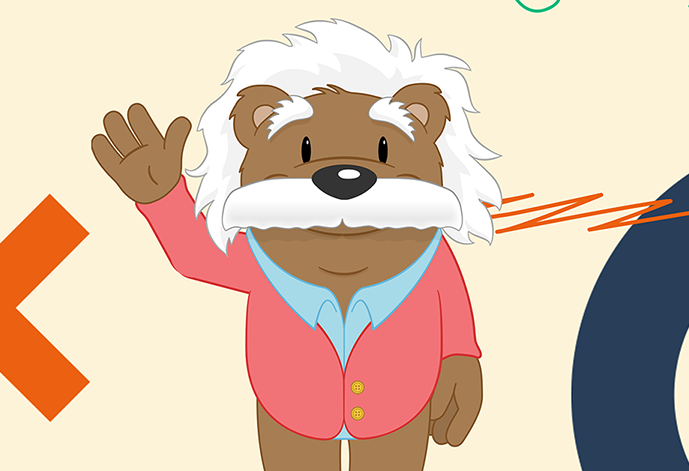
Meet Albert. Albert the Bear. Named, of course, after Albert Einstein.
Why Einstein? And Why a Bear?
The easy route would have been straightforward. Make the mascot a number, or a geometric shape with a friendly face, or some abstract representation of mathematics itself. Clean, simple, obviously related to the subject matter.
But here's the thing about mathematics that often gets lost in how we teach it: mathematics is profoundly human.
Behind every theorem, every formula, every concept that students encounter, there are real people who wondered, struggled, experimented, failed, tried again, and eventually discovered something true about how the world works. Mathematics didn't emerge fully formed from nowhere. It was created by curious humans asking questions and pursuing answers with creativity and persistence.
Albert Einstein represents that human side of mathematical thinking better than almost anyone else. He's famous, yes, but not in the distant, untouchable way that some historical figures are. Children know his name. They've seen his photograph, the wild hair, the playful expression. He feels accessible even though his work was revolutionary.
Einstein didn't just calculate. He imagined. He thought in pictures and metaphors. He asked "what if?" questions that seemed absurd until they turned out to be true. He combined rigorous mathematical thinking with childlike wonder about how the universe actually works.
That's the spirit we wanted for myBlee. Not mathematics as rigid memorization of procedures, but mathematics as creative exploration. Not intimidating perfection, but playful curiosity. Not getting the right answer to move on, but genuinely wondering why things work the way they do.
And the bear? Well, bears are friendly. Bears are curious. Bears are approachable in a way that even the most playful photograph of a physicist isn't, especially when you're seven years old and opening a mathematics app for the first time.
So we created Albert: Einstein's curiosity and creativity in the form of a character that children actually want to learn with.
The Mathematicians Children Should Know (But Usually Don't)
Here's something interesting about how we teach mathematics: we teach the concepts, but we rarely teach the people.
Children learn about fractions without ever hearing about the ancient Egyptians who developed fractional notation. They practice algebra without knowing about al-Khwarizmi, the Persian mathematician whose name literally gave us the word "algorithm." They work with zero without learning about the Indian mathematicians who first treated it as a number rather than just a placeholder.
When mathematics feels like a series of disconnected rules handed down from nowhere, it's easy for students to feel like they're either naturally good at it or naturally bad at it. Like it's a fixed trait rather than a skill built through curiosity and practice.
But when students understand that real people created these ideas, often through years of wondering and experimenting and making mistakes, something shifts. Mathematics becomes something humans do, not something you either get or don't get.
Take Emmy Noether, for instance. She revolutionized abstract algebra and theoretical physics, but had to fight for the right to even attend university lectures, let alone teach them. Her persistence in the face of systemic barriers and her brilliant work in symmetry and conservation laws changed mathematics fundamentally. That story matters. It tells students that mathematics isn't just for people who found it easy from the beginning.
Or consider Maryam Mirzakhani, who grew up in post-revolution Iran dreaming of becoming a writer, not a mathematician. She didn't even like mathematics initially. But curiosity pulled her in, and she became the first woman to win the Fields Medal for her work on the geometry of curved surfaces. She described her research as being like writing a novel, exploring an imaginary landscape. That reframes what mathematical thinking can feel like.
Srinivasa Ramanujan taught himself mathematics from outdated textbooks in colonial India and developed thousands of original theorems, many of which mathematicians are still working to fully understand over a century later. His intuition for number theory was so extraordinary that even trained mathematicians initially thought some of his formulas must be wrong, until they verified them and realized he'd discovered something profound.
These aren't just historical footnotes. They're reminders that mathematics is created by real people with different backgrounds, different obstacles, different ways of thinking. Some were child prodigies. Others discovered their love of mathematics later. Some worked in prestigious universities. Others worked in isolation with limited resources. What they shared was curiosity and persistence.
What Einstein Got Right About Learning
Einstein himself had thoughts about education, and they're worth remembering.
He once said, "It is the supreme art of the teacher to awaken joy in creative expression and knowledge." Not competence first, not skill-building first, but joy. The sense that learning is worthwhile because it's intrinsically interesting, not because you'll be tested on it later.
He also famously struggled in traditional educational settings. Despite popular myth, he was actually a strong student, but he chafed against rigid, authoritarian teaching methods that emphasized memorization over understanding. He learned best when he could explore, question, and connect ideas in his own way.
This is precisely what modern educational research confirms: students learn most effectively when they're curious, when they have some autonomy in their learning process, when they can make connections between ideas rather than treating each concept as isolated.
That's what Albert the Bear represents. Not just Einstein's genius, but his approach to learning itself. Mathematics as exploration, not recitation. Understanding as the goal, not just correct answers. Joy in the process, not just relief when it's over.
Making Mathematics Feel Human Again
When children first encounter Albert in the myBlee platform, they're meeting a friendly character who makes them feel welcome. That's the surface level, and it matters tremendously. A warm, approachable mascot reduces anxiety and creates a sense of safety that makes learning possible.
But underneath that immediate appeal is something more significant: Albert represents the human story of mathematics.
Every concept students practice has a history. Every formula they learn was discovered by someone who wondered, experimented, failed, tried again. The mathematics they're learning isn't arbitrary. It's the accumulated wisdom of thousands of years of human curiosity about how quantities work, how shapes relate, how patterns emerge, how the universe can be described with precision and beauty.
When we named our mascot after Einstein, we weren't just picking a famous name. We were making a statement about what we believe mathematics education should be. Not intimidating. Not cold. Not disconnected from the people who created it and the wonder that drove them.
Mathematics is a human endeavour. It deserves to be taught like one.
And if a friendly bear named Albert can help children remember that, well, that's exactly what he's there for.
The Mascot is the Message
There's a reason we didn't choose a cartoon calculator or a smiling number or some abstract symbol. We chose a character with a name that honours someone specific, someone whose approach to understanding the world embodied curiosity, creativity, persistence, and joy.
Because that's what we want every child to experience with mathematics. Not anxiety and memorization, but genuine wonder. Not the pressure to get everything right immediately, but the freedom to explore, make mistakes, try again, and discover something true.
Albert Einstein spent his life asking beautiful questions about space, time, gravity, and light. He approached the universe with a sense of playfulness even as he developed theories that changed human understanding fundamentally.
Albert the Bear carries that same spirit into mathematics classrooms. A reminder that behind every equation is a human story, and that learning mathematics can be an adventure rather than an ordeal.
Who wouldn't want to learn math from a friendly bear named after a genius? More importantly, what might children discover about themselves and mathematics when they do?