Division That Actually Makes Sense
Ask a fourth grader what division means, and you'll likely get an answer about times tables or long division. Ask them to explain why the division algorithm works, and you'll probably be met with silence. This isn't because students aren't paying attention or working hard enough. It's because traditional division instruction focuses on procedures before understanding.
The conventional approach to teaching division follows a predictable pattern: memorize your multiplication tables, learn the division algorithm, practice until you can execute it correctly. For some students, this works well enough. They can follow the steps, get correct answers, and move forward. But for many others, division remains a mysterious process, a series of steps they execute without understanding why those steps work or what division actually represents.
The Problem with Procedure-First Instruction
When we teach division as a procedure to memorize rather than a concept to understand, we create several problems that compound over time. Students learn that 24 divided by 4 equals 6, but they don't necessarily understand what that means. Is division about sharing? About grouping? About finding how many times one number fits into another? Without this conceptual foundation, division becomes fragile knowledge that doesn't transfer to new contexts.
This approach also creates unnecessary anxiety. Students who struggle to memorize the steps of long division begin to believe they're "bad at math," when in reality they simply haven't been given the opportunity to understand what division means before being asked to calculate it. The algorithm becomes a black box, something that either works or doesn't, with no way to check whether an answer makes sense.
Perhaps most problematically, procedure-first instruction fails to build the number sense students need for more advanced mathematics. When students don't understand division conceptually, they struggle with fractions, ratios, rates, and algebra. These topics all rely on a deep understanding of what it means to divide quantities, and memorizing an algorithm doesn't provide that understanding.
What Division Actually Means
Before students can truly master division, they need to understand what division represents. And here's what makes division challenging: it actually represents multiple related concepts. Division is equal sharing, splitting a quantity into a specified number of groups. Division is also repeated subtraction, determining how many times you can remove a quantity from a larger amount. And division is the inverse of multiplication, finding the missing factor in a multiplication equation.
These aren't three different operations that happen to use the same symbol. They're three different ways of thinking about the same mathematical relationship. Deep understanding of division means grasping all three perspectives and recognizing when each is most useful.
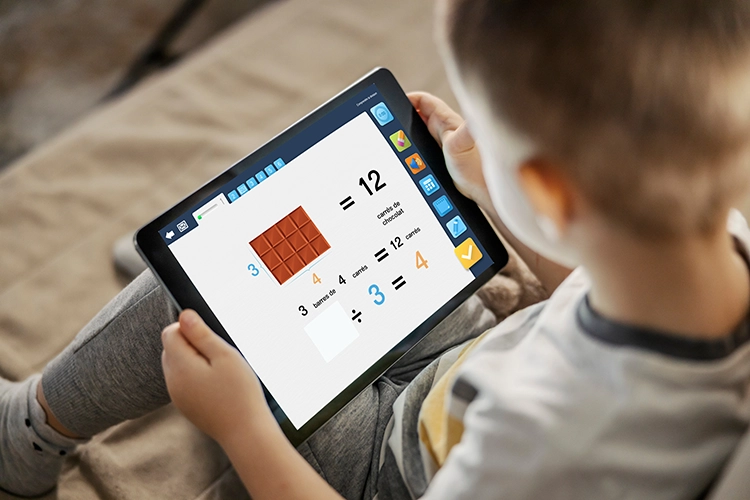
This is why myBlee's approach to division is fundamentally different from traditional instruction. We don't start with memorization or algorithms. We start by helping students understand what division actually means through concrete, tangible experiences.
Starting with Concrete Sharing
In myBlee's division modules, students begin with the most intuitive model of division: sharing objects equally. Imagine you have 12 cookies and want to share them equally among 3 friends. How many cookies does each friend get? This is a problem that makes sense to students because it connects to their lived experience.
Students work with digital manipulatives to actually distribute objects into groups, seeing and experiencing what equal sharing looks like. They might drag 12 objects into 3 groups, ensuring each group has the same number. This concrete experience builds the foundation for understanding division as partitioning a whole into equal parts.
But we don't stop with sharing. Students also explore division as grouping: if you have 12 cookies and want to give 3 cookies to each friend, how many friends can you serve? This is a different question with the same numbers, and it represents a different way of thinking about division. By working with both models concretely, students develop flexible understanding of what division can represent.
Moving to Visual Models
Once students have worked extensively with concrete manipulation, they're ready for the representational stage: working with visual models. At this stage, students still aren't working with abstract numbers and algorithms. Instead, they're using pictures, diagrams, and visual representations to think about division.
Students might represent 24 divided by 4 as circles grouped into sets, or as a number line with jumps of 4. They learn to draw division situations, creating visual models that show the relationships between quantities. These visual representations serve as a bridge between concrete manipulation and abstract calculation.
This stage is crucial because it helps students internalize division concepts. They're no longer dependent on physical objects to think about division, but they're not yet working purely symbolically. They're building mental models that will support abstract thinking later.
Progressing to the Standard Algorithm
Only after students have developed deep conceptual understanding through concrete and representational work do they move to the abstract stage: the standard division algorithm. But now, this algorithm isn't a mysterious procedure. It makes sense because students understand what division means.
When students work through long division, they can connect each step to the concrete actions they performed earlier. Dividing the first digit relates to creating the first group. Multiplying and subtracting relates to seeing how many objects remain to be distributed. Bringing down the next digit is like adding more objects to share.
The algorithm becomes a shorthand for a process students already understand, rather than a confusing set of steps they must memorize without comprehension.
Three Modules, Six Levels Each
myBlee structures division instruction through three comprehensive modules, each containing six levels of increasing difficulty. This careful scaffolding ensures that students build understanding gradually, mastering simpler concepts before advancing to more complex ones.
Students don't rush through division in a few lessons and then move on. They spend time at each level, working with different representations, exploring different contexts, and building robust understanding that doesn't fade after the test. This depth of instruction is what transforms division from a topic students survive into a concept they genuinely understand.
Division as Multiple Concepts
Throughout these modules, students encounter division from multiple perspectives. They work with division as equal sharing, distributing quantities into groups. They explore division as repeated subtraction, determining how many times they can remove a quantity. They understand division as the inverse of multiplication, finding missing factors.
This multi-faceted understanding is what separates students who can calculate from students who can think mathematically. When faced with a word problem, students who understand division conceptually can determine what kind of division situation they're encountering and choose an appropriate strategy. Students who only know procedures struggle to know when and how to apply what they've learned.
Understanding That Sticks
The difference between myBlee's approach and traditional instruction shows up most clearly over time. Students who learn division through concrete-to-abstract progression don't just pass tests; they retain understanding. They can return to division concepts months later and still remember what division means, not just how to calculate it.
This lasting understanding happens because students have built genuine conceptual knowledge, not just memorized procedures. They've experienced division in multiple ways, connected it to their intuition, and developed mental models they can rely on.
When these students encounter division in new contexts, like dividing fractions or working with algebraic expressions, they have a foundation to build on. Division isn't a mysterious operation; it's a familiar concept being applied in new ways.
More Than Test Performance
Traditional division instruction aims for correct answers on assessments. myBlee aims for something more ambitious: mathematical understanding that transfers across contexts and lasts beyond the test.
This is division that makes sense. Division that students can explain, not just execute. Division that connects to students' intuition and experience. Division that prepares students not just for the next test, but for the mathematical thinking they'll need throughout their education and lives.
Because when we take the time to build genuine understanding through concrete experiences, visual representations, and gradual progression to abstract thinking, students don't just learn to calculate. They learn to think mathematically. And that's an outcome worth investing in.