The Hidden Challenge Bilingual Schools Face: When Mathematics Speaks Two Languages
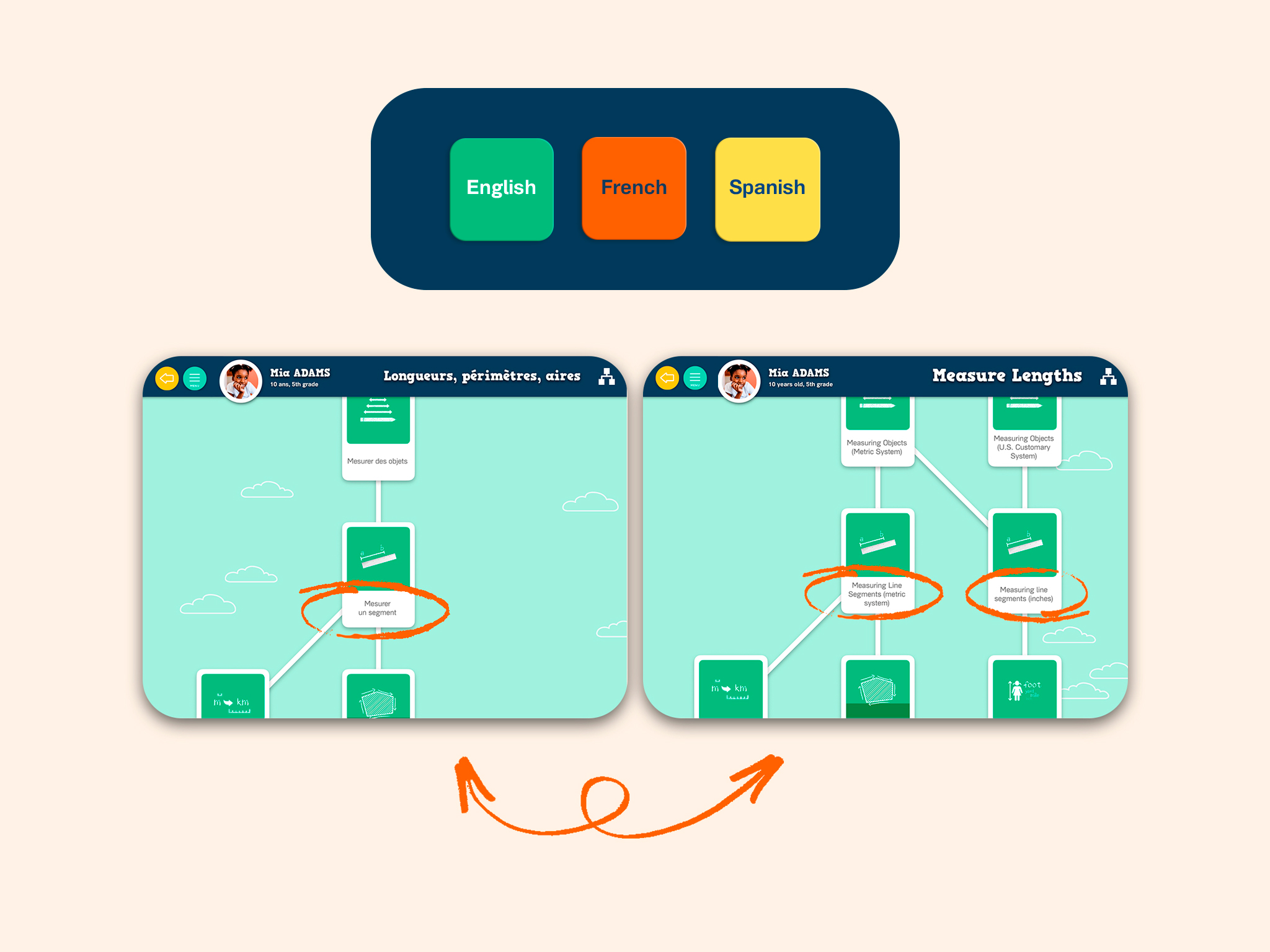
There's a moment that happens in bilingual classrooms around the world, and it's confusing for everyone involved.
A student sits down on Monday morning with their English-speaking mathematics teacher. They're learning long division. The problem is straightforward: 72 ÷ 9. The teacher writes it on the board: 9)72, with the divisor outside and the dividend tucked inside. The student practices, gets comfortable with the notation, understands the steps.
Wednesday arrives. The same student, same concept, but now with their French-speaking teacher. The teacher writes the same problem on the board. Except this time, it looks completely different. There's a vertical bar, the numbers are positioned differently, the visual logic has shifted entirely.
The student hesitates. They understood this on Monday. Why does it look wrong now?
When Notation Becomes a Barrier to Understanding
This isn't a language problem. It's a mathematical culture problem.
We talk about mathematics as a universal language, but that's only partially true. While mathematical concepts transcend borders, the way we write mathematics absolutely does not. Long division in the United States follows different conventions than long division in France. Column addition formats vary between the UK and Switzerland. Even something as simple as a decimal point becomes a comma when you cross certain borders.
For students in international and bilingual schools, who often receive instruction in multiple languages throughout the week, these notation differences create unnecessary cognitive friction. They're not struggling with the mathematics itself, they're struggling with conflicting visual systems.
And here's what makes it worse: most educational technology tools pick one notation system and stick with it. They're built for single-curriculum schools in single markets. They export well to other countries, but they don't actually adapt.
What Pedagogy-First Design Looks Like in Practice
This is where myBlee takes a different approach.
The platform was designed specifically for the reality of international schools: students who move fluidly between languages and curricula, teachers who need resources that match their pedagogical training, and schools that serve diverse populations with different mathematical traditions.
Here's how it works in practice:
A student begins a division lesson in English. The notation follows US Common Core conventions. The language is American English. The pedagogical progression matches what their US-trained teacher expects.
Mid-week, they continue with their French-speaking teacher. MyBlee recognizes the language switch and automatically adjusts. The same mathematical concept, now presented with French notation, French terminology, and the pedagogical sequence familiar to the French Education Nationale system.
The student experiences continuity of learning, not disruption. The concept remains consistent even as the presentation adapts.
Respecting Cultural Differences in Mathematics Education
This isn't about preference. It's about respecting that mathematics pedagogy has evolved differently across cultures, and those differences matter.
French mathematics education emphasizes certain approaches to problem-solving that differ from Anglo-Saxon methods. Singapore Math uses visual models that have specific cultural and pedagogical roots. Swiss HarmoS follows progressions distinct from the IB Primary Years Programme.
myBlee doesn't flatten these differences. It honours them.
When you select your curriculum, whether it's French Education Nationale, US Common Core, UK National Curriculum, Swiss HarmoS, or IB PYP, and choose your language, the platform adapts everything: notation, terminology, and pedagogical approach.
Purpose-Built for International Education
This is what it means to design technology for education, rather than designing education around technology.
Most EdTech platforms ask schools to adapt to their system. MyBlee adapts to the school's reality.
For international schools navigating multiple curricula, serving bilingual populations, and employing teachers trained in different pedagogical traditions, this distinction matters. It's the difference between technology that adds complexity and technology that reduces it.
Mathematics should be challenging because the concepts are rich and worth grappling with. It shouldn't be challenging because the notation keeps changing for no pedagogical reason.
That's a problem worth solving. And it's a problem that requires understanding education first, deeply and thoroughly, before writing a single line of code.