Mathematics: The Hidden Language of Everything
There's a moment in mathematics education when everything changes. A student working through fraction problems suddenly notices spiral patterns in a pinecone, or realizes musical notes are mathematical ratios, or sees repeating wave patterns on a beach. Mathematics stops being something confined to workbooks and becomes something that exists independently in the world. That shift, from "doing math" to "seeing math," transforms not just how students feel about the subject, but what becomes possible for them to understand.
The Universe Already Speaks Mathematics
Mathematics didn't originate in textbooks. Ancient people noticed the moon's phases repeated in cycles, certain star patterns appeared seasonally, and specific ratios in music sounded harmonious. They weren't inventing mathematics; they were discovering it, the same way you discover water freezes at a certain temperature.
Once you start looking, you see it everywhere. Count the spirals in a sunflower's seed head clockwise and counterclockwise, and you'll almost always get consecutive Fibonacci numbers: 34 and 55, or 55 and 89. The sunflower isn't consciously doing mathematics. It's following growth patterns that evolved because the Fibonacci sequence produces the most efficient seed packing.
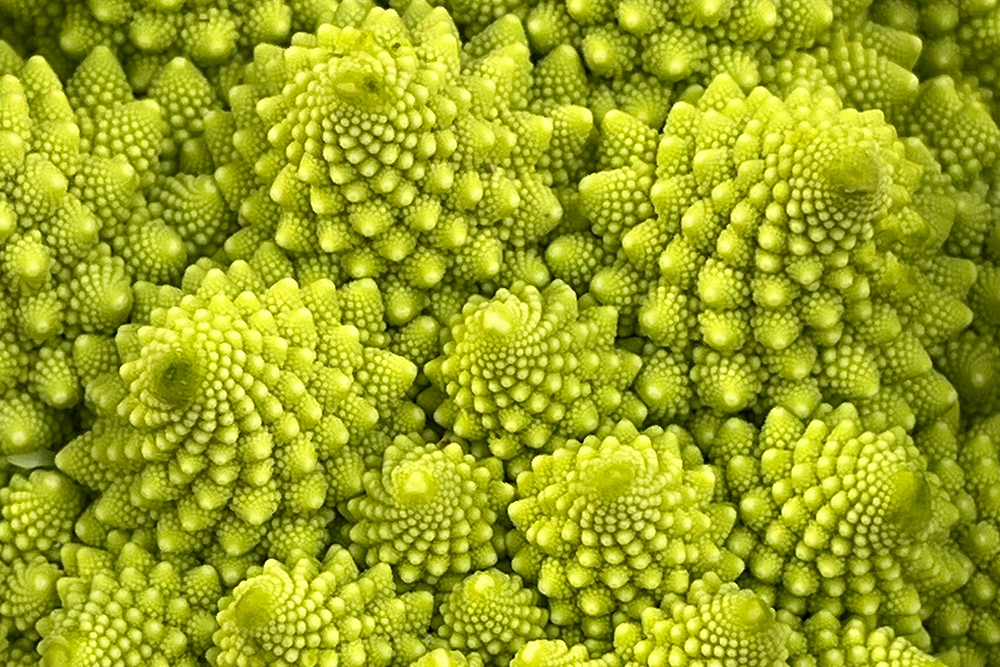
This same sequence appears in pinecones, pineapples, romanesco broccoli, leaf arrangements, and tree branching, not because someone programmed it, but because these ratios represent optimal solutions to spacing problems. Mathematics isn't being imposed on nature. It's emerging from how physical systems naturally organize themselves.
Watch a murmuration of starlings move in coordinated waves, and you're witnessing geometry in motion. Each bird follows simple local rules, yet the flock creates patterns described by the same mathematics that explains traffic flow and information spread. Rivers meander in curves that follow mathematical patterns, with their actual length to straight distance ratio clustering around pi.
Music reveals its mathematical foundation in harmonious frequency ratios: an octave is 2:1, a perfect fifth is 3:2. When two frequencies have simple ratios, their sound waves align in regular patterns your brain recognizes as harmony.
Patterns That Repeat, Connect, and Predict
Fractals show similar structure whether you're viewing the whole or zooming into tiny details. Coastlines are fractal; satellite images show jagged complexity that continues at smaller and smaller scales. This creates an interesting measurement problem: the length depends on your precision.
Use a meter stick and get one answer, use a centimeter ruler and capture more detail for a longer measurement. Clouds, mountains, and tree branches all display this self-similarity because natural growth involves repeated application of similar rules at different levels. Symmetry appears everywhere for survival reasons.
Butterflies have bilateral symmetry; starfish show radial symmetry. But symmetry goes deeper than visible patterns. Crystals grow in symmetric patterns because of molecular-level atomic arrangements. Snowflakes show six-fold symmetry because water molecules bond in hexagonal arrangements when freezing.
Probability gives us language to talk precisely about uncertainty. When a forecast says seventy percent chance of rain, it means precipitation occurred in roughly seven out of ten similar historical situations. Rolling dice seems random at the individual level, but over many rolls follow predictable patterns.
The golden ratio, about 1.618, appears in nautilus shell spirals, galaxy spirals, the Parthenon's proportions, and leaf arrangements that maximize sunlight. When spirals grow maintaining the same shape at different sizes, mathematics constrains what ratios are possible.
When Students Stop Asking "When Will I Use This?"
The standard question teachers hear is "when will I ever use this in real life?" It's fair when mathematics feels like arbitrary rules to memorize. But when students start seeing mathematics in the world around them, everything changes.
They stop asking when they'll use quadratic equations because they've seen parabolas in thrown objects, satellite dishes, and suspension bridge cables. They stop asking why ratios matter because they've noticed recipe scaling, map reading, and paint mixing all involve the same reasoning. They stop asking why they need probability because they realize understanding likelihood helps interpret medical information and make decisions about uncertain outcomes.
The question shifts from "when will I use this?" to "what else can I discover?" That shift changes everything about how students engage with mathematics. There's a fundamental difference between completing exercises and recognizing mathematical structure in the world. Both matter.
Students need computational fluency and problem-solving skills that exercises build. But when education focuses exclusively on procedures, students can execute algorithms competently while thinking mathematics is an arbitrary game with no connection to reality.
The transformation happens when students realize the mathematics they're learning isn't invented busywork. It's a language for describing patterns that already exist.
Teaching Mathematics as Discovery
The challenge for educators is creating opportunities for these connections without making mathematics feel contrived. Showing a nautilus shell picture and saying "look, golden ratio!" isn't enough. Students need to understand what the golden ratio is, why it appears in growth patterns, what makes it mathematically special.
The connection needs depth, not just surface pattern matching. This requires weaving real-world connections throughout mathematics instruction as fundamental to how concepts are introduced and understood. When teaching ratios, start with actual proportional relationships.
When teaching geometry, examine actual structures in architecture and nature. When teaching probability, analyze actual uncertain situations students care about. Mathematics becomes a tool for understanding what's already interesting, rather than an abstract topic made slightly more palatable by pointing out occasional applications. Here's something important: children are naturally curious about patterns.
Young children notice symmetry without being taught the word. They recognize repetition. They're fascinated by how structures fit together, by patterns in music, by how objects move. The problem isn't that children don't care about mathematical ideas. The problem is when we present mathematics as divorced from everything they find naturally interesting.
The Moment Everything Changes
When a student stops doing math and starts seeing math, several things happen simultaneously. Mathematics becomes interesting for its own sake, not just as a requirement to pass. When you recognize mathematical patterns everywhere, noticing new instances becomes intrinsically rewarding. Mathematics education gains purpose beyond grades and tests.
Students understand they're learning a genuine language for describing reality, not arbitrary procedures invented to make school difficult. The difficulty of mathematics becomes acceptable. Hard things are worth struggling with when you understand why they matter. Students develop agency in their mathematical learning. They don't just wait for teachers to show them what's important.
They start noticing mathematical connections on their own, asking questions, making observations. Mathematics wasn't invented to torture students with worksheets. It emerged from humans trying to describe patterns we observed. The spirals in sunflowers, the ratios in music, the fractals in coastlines, the symmetry in butterflies existed long before we developed notation to describe them.
When we teach mathematics well, we're not imposing arbitrary rules. We're teaching students to read the language the universe has been speaking all along. A student who sees Fibonacci in a pinecone, recognizes parabolic motion in a thrown ball, understands exponential growth in viral spread, and identifies geometric transformations in art has gained something profound.
Not just mathematical skills, but a different way of seeing the world. And once you start seeing it, you can't unsee it. The spirals, the ratios, the symmetries, the patterns repeating at every scale. Mathematics everywhere, hiding in plain sight, revealing itself to those who've learned its language.