Teaching Measurement on a Screen: How Digital Rulers Can Feel More Real Than Physical Ones
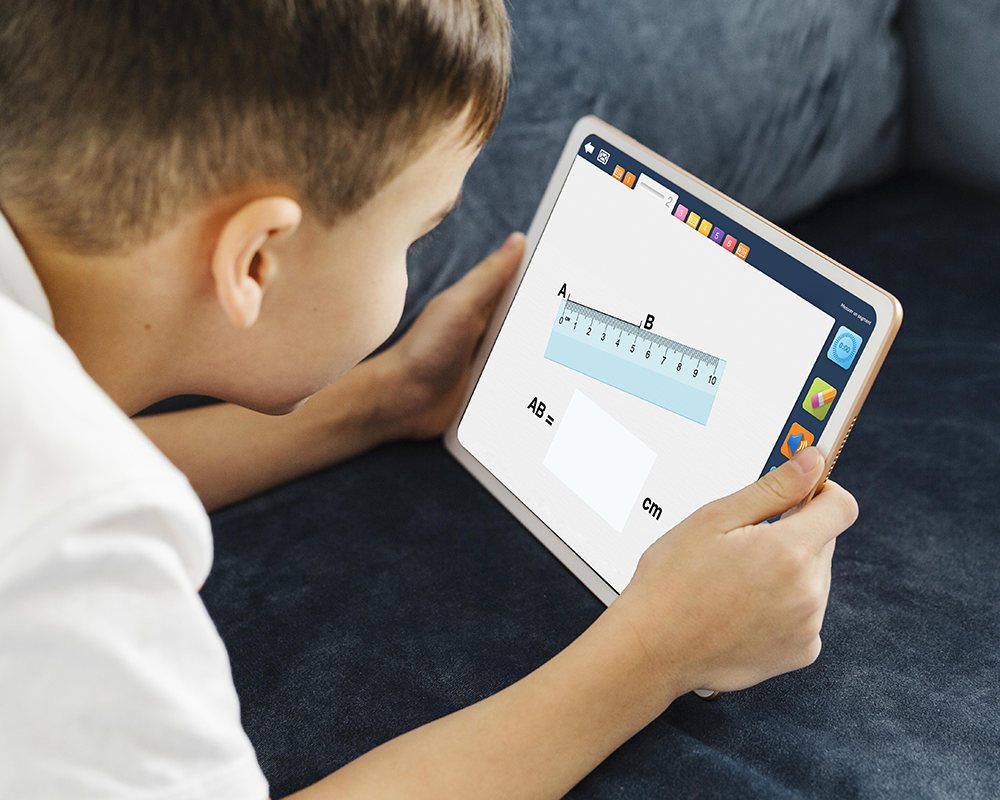
How do you teach precise measurement on an iPad? It seems counterintuitive. Measurement is inherently physical: you hold a ruler, place it against an object, align the zero mark carefully, read where the object ends. It's tactile, spatial, hands-on in the most literal sense. So how could a digital version possibly work?
The answer is more interesting than the question. When you design thoughtfully, a digital ruler can actually teach measurement skills better than a physical one, not by replacing the physical experience, but by removing the obstacles that often prevent students from learning what they're supposed to learn in the first place.
Why Measuring Line Segments is Harder Than It Looks
Hand a child a ruler and ask them to measure a line segment. Watch closely and you'll see a dozen ways this seemingly simple task can go wrong. Some students place the ruler so the line starts at the one-centimeter mark instead of zero, then read the measurement without accounting for the offset.
Their answer is consistently one centimeter too short, and they have no idea why. Others align the ruler at an angle instead of parallel to the line. Some students read from the wrong edge, using inches when the task requires centimeters. Others struggle when the endpoint falls between marks. Is it closer to four or five? Should they estimate? Round?
They're not sure, so they guess. Measurement requires careful attention to alignment, scale, and reading exactly where the endpoint sits. It's a skill combining spatial reasoning, fine motor control, attention to detail, and number sense all at once. For students who find any of those component skills challenging, physical measurement becomes frustrating quickly.
The ruler isn't providing feedback. It's just sitting there, a passive tool that reveals nothing about technique. Layer on the practical realities of teaching measurement to thirty students simultaneously. You distribute rulers. Half the class has metric rulers, half has both metric and imperial measurements crammed into tiny print.
Three students forgot their rulers. Two rulers are cracked. You demonstrate proper technique at the front of the room. Some students see clearly. Others are sitting too far away to observe the crucial detail of aligning to zero. Students begin measuring. You circulate, correcting techniques individually.
By the time you've corrected everyone once, the students you helped first have moved on to new problems and developed new errors. There's no immediate feedback mechanism. Students measure, write down their answer, and don't know if it's correct until you check later.
What Thoughtfully Designed Digital Rulers Can Do
In myBlee's Measuring Line Segments module, students work with a digital ruler that behaves exactly like a physical one in every way that matters for learning measurement skills. They see a line segment on screen. They have a digital ruler they can move and position.
Their task is exactly what it would be with paper and a physical ruler: place the ruler against the line, align it properly, read the measurement. The difference is what happens next. When a student places the ruler but forgets to align the zero mark with the starting point, the system knows. When they read from the wrong end or miscount the marks, the system knows. When their measurement is accurate, the system knows that too.
Instant feedback means students don't practice errors. They attempt a measurement, receive immediate confirmation or correction, adjust their approach, try again. The learning loop is tight and responsive in a way that physical measurement can never be when one teacher is supporting thirty students. myBlee's measurement module doesn't throw students into complex tasks and hope for the best.
It builds skills incrementally across six levels of difficulty, adding complexity only when students demonstrate readiness. Early levels might present perfectly horizontal line segments with clear endpoints at whole number values. The ruler is already oriented correctly. Students focus on core skills: aligning to zero, reading the scale, identifying the measurement. As students progress, challenges increase gradually.
Line segments appear at different positions, requiring students to move and position the ruler themselves. Endpoints fall between marked values, requiring estimation and precision. Multiple units appear, asking students to choose the appropriate scale. This progression isn't arbitrary.
It's designed around how skill acquisition actually works. You isolate the fundamental technique first, build confidence through successful practice, then layer in additional complexity once the foundation is solid.
What Students Actually Learn
The goal isn't to make students good at measuring things on an iPad. The goal is to develop genuine measurement skills that transfer to the physical world. When students complete the module, they've internalized several crucial understandings that apply to any measurement context, digital or physical.
They understand that zero alignment matters. The starting point must align with the zero mark on your ruler, not with the physical edge of the ruler itself. This seems obvious to adults but is genuinely confusing for many children until they experience the consequences of misalignment repeatedly and learn to self-correct. They understand scale selection. Rulers often have multiple scales.
Students learn to identify which scale they're supposed to use and how to read it accurately. They understand precision in reading measurements. When an endpoint falls between two marks, students learn to estimate the fractional value rather than just rounding to the nearest whole number. They develop the spatial awareness required for proper alignment. These are transferable skills.
When a student who's mastered digital measurement picks up a physical ruler to measure something in the real world, the technique is already internalized. They know to check zero alignment. They know to read the correct scale. They know to look carefully at where the endpoint falls. The digital practice prepared them for physical application precisely because it focused on the same fundamental skills, just with better feedback during the learning process.
The Practical Advantages Are Real
Beyond pedagogical benefits, there are straightforward practical advantages. No broken rulers. No lost rulers. No fighting over the three rulers that actually have clear markings. No students who forgot their ruler and can't participate. No storage bins full of measurement tools in various states of disrepair. No paper waste.
Traditional measurement practice involves worksheets with line segments printed for students to measure. Students measure once, the worksheet is complete, it gets filed or recycled. With digital practice, students can work through hundreds of measurement exercises without consuming any paper.
No grading delays. Students receive immediate feedback on every measurement rather than waiting for the teacher to check their work later. This means more practice, faster iteration, quicker skill development. And perhaps most significantly: every student gets focused, individualized practice at their appropriate level of challenge.
The student who needs more time on basic alignment can work through additional level one exercises. The student who's ready for complex measurements can advance immediately. Nobody is held back waiting for the class to move together. Nobody is pushed forward before they're ready.
When Digital Tools Serve Real Learning Goals
Digital rulers, when designed well, aren't technology for its own sake. They're a genuine improvement on physical measurement practice for initial skill development. They preserve everything important about learning to measure: the need to position carefully, read accurately, understand scale and precision.
They add what physical tools can't provide: immediate feedback, adaptive progression, individualized pacing, consistent access for every student. This isn't about replacing all physical measurements forever. Students will still use real rulers in science labs, in art projects, in real-world contexts where actual objects need measuring. The digital practice prepares them to use physical tools effectively by building the foundational skills in an environment where errors can be identified and corrected immediately.
Measurement is one of those skills that follows you through life. Adults measure constantly. Furniture to see if it fits. Ingredients for recipes. Distances for projects. Dimensions for online orders. When we teach measurement well, we're not just preparing students for geometry tests.
We're giving them tools they'll actually use, confidence in their ability to work with precision, understanding of how to use instruments correctly. A digital ruler that works exactly like a physical one, but with instant feedback, adaptive progression, and consistent access for everyone? That's not technology replacing education. That's technology serving it.