Beyond the Worksheet: Why Repetition Still Works (When Done Right)
If you taught mathematics in the 1990s or 2000s, or if you were a student then, you probably have memories of Kumon worksheets. Rows and rows of problems. Addition facts. Subtraction drills. Multiplication tables. The same operation type repeated twenty, thirty, forty times on a single page.
Some students thrived, working through stacks of worksheets, building computational fluency through sheer systematic practice. Mastery through repetition. It worked. Other students struggled, making the same mistake repeatedly across an entire page, reinforcing the error rather than correcting it.
By the time the worksheet came back marked, they'd already practiced the wrong method dozens of times. The Kumon model had something powerful: a clear methodology rooted in incremental skill-building through focused, repetitive practice. But it also had significant limitations that modern education has the tools to address. The question isn't whether we should abandon systematic practice. It's whether we can preserve what works while solving what doesn't.
Why Repetition Actually Matters (And Where Paper Falls Short)
Before we dismiss worksheets, let's acknowledge why repetitive practice exists in the first place. Mathematics requires both conceptual understanding and procedural fluency. You need to understand why multiplication works, but you also need to retrieve 7 × 8 automatically without counting on your fingers. Fluency matters because it frees up cognitive space for complex problem-solving.
When students are still laboriously calculating 6 + 7, they can't focus on the algebraic reasoning required for multi-step word problems. This is where systematic, repetitive practice comes in. Repeated exposure to similar problems allows students to develop automaticity with foundational skills, recognize patterns across problem types, build confidence through incremental success, and consolidate learning through distributed practice.
The Kumon model understood this. Its strength wasn't just repetition; it was structured repetition. Problems increased in difficulty gradually. Skills were isolated before being integrated. Students practiced until mastery before advancing. That pedagogical foundation is sound, backed by cognitive science research on how memory consolidation and skill acquisition actually work.
The problem was never the methodology. The problem was the medium. Paper worksheets can't provide immediate feedback. A student completes thirty division problems using an incorrect algorithm, practicing the wrong method thirty times, strengthening a misconception.
By the time the teacher grades the worksheet, maybe that evening, maybe two days later, the student has moved on mentally. Paper worksheets can't adapt to individual readiness. Everyone gets the same problems regardless of whether they're ready to advance or need more foundational support.
The student who masters addition facts in ten problems doesn't need forty more. Meanwhile, the student still confusing place value needs targeted intervention, not just more of the same. Paper worksheets don't show teachers where students are struggling. A graded worksheet tells you who got which problems wrong. It doesn't tell you why.
Without diagnostic insight, teachers can see that a student struggled but have to guess at the specific intervention needed. And if you have 120 students across four classes, grading paper practice worksheets is a massive time investment, time you could spend planning, conferencing with students, or resting.
What Happens When You Upgrade the Medium, Not the Methodology
Modern platforms like myBlee preserve what worked about systematic practice while addressing every limitation. The methodology stays the same: focused, repetitive practice on specific skills, incremental difficulty progression, mastery-based advancement, systematic skill-building.
The execution gets better. Instant feedback means students know immediately if their answer is correct. They can adjust their approach on problem five, not after completing all thirty. Errors don't get reinforced; they get corrected in the moment. Adaptive progression means students who demonstrate mastery quickly advance to more challenging material. Students who need more support get additional scaffolded practice.
Everyone works at their frontier of learning, not their grade's average pace. Diagnostic analytics show teachers exactly where students are struggling, not just which problems were missed, but what type of errors are occurring. Calculation mistakes versus conceptual confusion versus reading comprehension issues. Teachers can intervene precisely instead of guessing.
Automated tracking compiles data automatically. Teachers see class-wide patterns and individual progress over time without manually entering scores into spreadsheets. A typical scenario: students are practicing multiplication of fractions. On paper, you'd distribute a worksheet with twenty problems, collect them tomorrow, grade them tomorrow night, return them the next day.
With digital practice through myBlee, students work through problems at their own pace, receive immediate confirmation or correction after each problem, automatically advance to more complex operations when ready, or receive targeted hints when making repeated errors.
The teacher sees in real-time that seven students are struggling with finding common denominators and can pull those students for small-group intervention now, while the concept is active, rather than discovering the gap three days later. Meanwhile, the five students who've mastered the skill aren't sitting idle; they're advancing to challenging applications that keep them engaged.
Keeping What Worked, Fixing What Didn't
Sometimes you still need paper. For homework when screen time is a concern. For formal assessments where you want consistency. For students who process better on paper. For classrooms with limited device access.
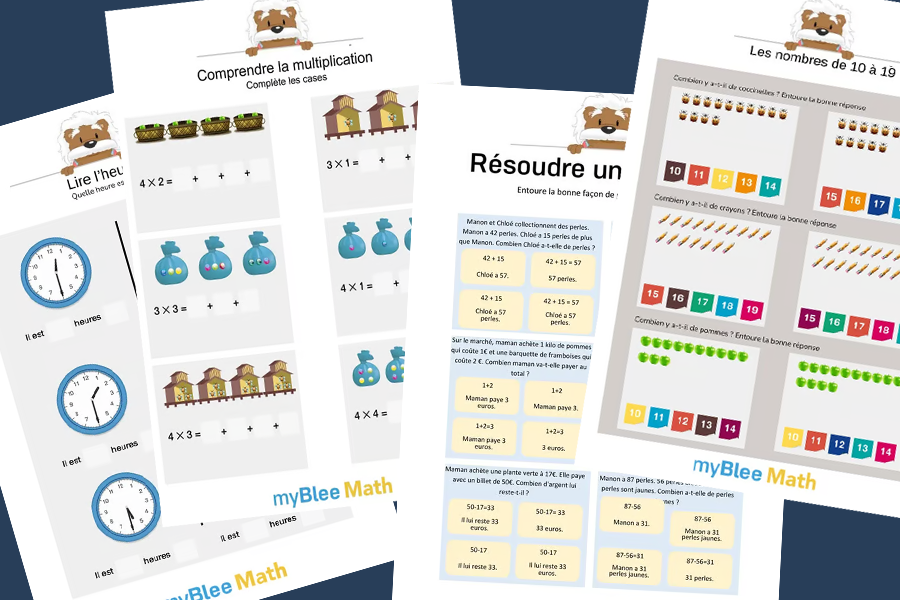
myBlee allows teachers to download printable worksheets aligned to the same progression students practice digitally. Same rigor, same methodology, different medium. You can assign digital practice for immediate feedback during class and send home printed practice for reinforcement.
You can use digital diagnostics to identify struggling students, then provide printed scaffolded support tailored to their needs. Technology isn't replacing worksheets; it's making them better and giving you options. Let's be honest about what matters most. Teachers don't have unlimited time.
Grading 120 worksheets weekly is unsustainable, especially when the grading provides limited diagnostic value and students have already moved on mentally. Students don't all learn at the same pace. When you upgrade from purely paper-based practice to a system that offers instant feedback, adaptive progression, and diagnostic analytics, two things happen.
Teachers reclaim time that was spent on low-value tasks like marking repetitive calculations and can redirect it to high-value teaching like small-group intervention, conceptual discussion, and individual conferences. Students build genuine mastery because practice is targeted to their actual level, errors are corrected immediately, and advancement is based on demonstrated competence rather than calendar pacing.
The Kumon model had something right: mastery comes from systematic, focused, repetitive practice. But the paper-based delivery created unnecessary friction. Modern educational technology, when designed thoughtfully, preserves the pedagogical strengths while eliminating the practical limitations. Same rigor. Better execution. Real results.