The Montessori Method and myBlee School: Why Touch Comes Before Theory
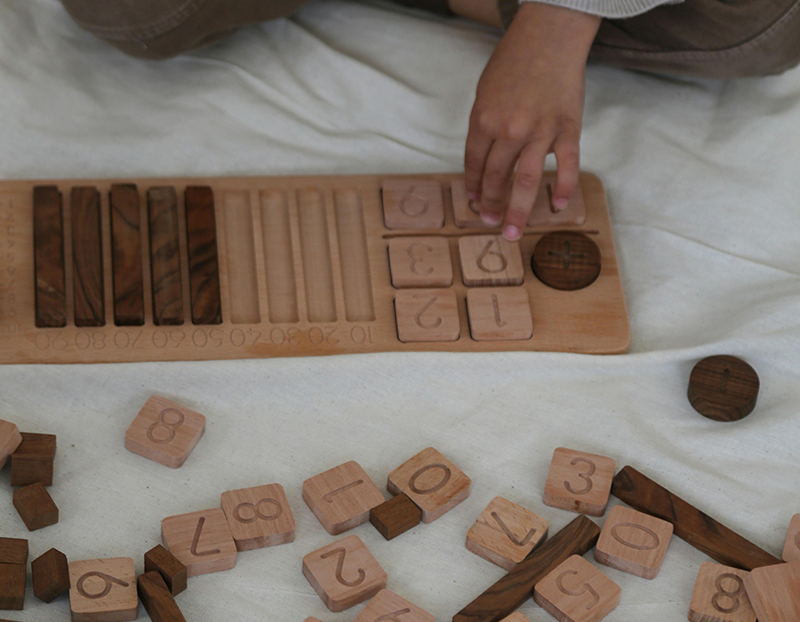
Over a century ago, an Italian physician named Maria Montessori made an observation that would transform education. While working with children in Rome's poorest neighborhoods, she discovered something that contradicted conventional teaching wisdom: children don't learn mathematics by listening to explanations or memorizing facts.
They learn by touching, manipulating, and experiencing mathematical concepts with their hands first. This insight, radical in her time and still underutilized today, forms one of the foundational pillars of myBlee's approach to mathematics instruction. Montessori understood what cognitive science would later confirm: the path to abstract understanding runs directly through concrete experience.
The Problem with Abstract-First Instruction
Walk into most mathematics classrooms, and you'll see instruction that begins with abstraction. Teachers write numbers on boards, explain operations with symbols, and ask students to work with mathematical notation from the very beginning. For some students, particularly those with strong abstract reasoning skills, this works adequately.
But for many others, it's like being asked to understand a language by reading the dictionary before ever hearing it spoken. When we teach place value by explaining that the digit in the tens place represents groups of ten, we're asking students to understand an abstract concept without giving them the concrete experience that makes that abstraction meaningful.
We tell them that 23 means two tens and three ones, and we expect this explanation to create understanding. But understanding doesn't work that way. The human brain, particularly the developing brain of a child, builds understanding by connecting new concepts to physical experience. Abstract symbols like "23" only become meaningful when they're anchored to concrete experiences of what two groups of ten and three individual units actually look and feel like.
Maria Montessori's philosophy was elegantly simple: students need concrete, hands-on experiences before they can understand abstract symbols and operations. This wasn't just a pedagogical preference. It was, in Montessori's view, the only way genuine mathematical understanding could develop. In a Montessori classroom, students don't memorize that ten units make one ten.
They experience it. They take ten individual unit cubes, small wooden blocks that fit in their hands, and they stack them. They feel the weight of ten individual cubes. They arrange them in a line and see how they form a bar. They physically construct the relationship between units and tens. This concrete experience creates understanding that no amount of explanation could match.
From Montessori Materials to Digital Manipulatives
The challenge in bringing Montessori's approach to a digital platform is preserving the essential quality of concrete manipulation while leveraging the unique advantages technology offers. This is exactly what myBlee has accomplished through our comprehensive system of digital manipulatives. Consider how myBlee brings the classic Montessori place value experience to life digitally. Students work with virtual cubes that they can stack and arrange on screen.
As they add individual unit cubes one by one, they're engaged in the same constructive process that Montessori students experience with physical materials. They count each cube: one, two, three, continuing up to ten. Here's where digital tools offer something physical materials cannot: when students stack their tenth cube, myBlee automatically changes the color of the stack to green.
This visual transformation provides immediate feedback that they've reached a significant mathematical milestone. They've constructed a group of ten, and the color change celebrates and confirms this achievement. This digital enhancement serves multiple purposes.
First, it provides instant feedback, helping students recognize patterns and relationships more quickly than with physical materials alone. Second, it allows students to work autonomously. Teachers don't need to circulate constantly, checking whether students have correctly grouped their materials. Students can work independently, experiencing the satisfaction of discovery without waiting for adult confirmation.
The Montessori principle of learning through construction extends far beyond place value. Take volume as an example. Traditional instruction teaches volume through formulas. Students learn that volume equals length times width times height, and they practice plugging numbers into this formula.
They might get correct answers, but do they understand what volume actually is? In myBlee's Montessori-inspired approach, students don't learn volume from formulas. They build 3D shapes cube by cube, literally constructing three-dimensional objects on screen. As they add each cube, they develop intuition about how space is measured.
They discover that a cube that's 3 units long, 2 units wide, and 2 units tall contains 12 cubic units because they've placed each of those 12 cubes themselves. This experiential understanding transforms how students think about volume. When they later encounter the formula, it's not a mysterious rule to memorize. It's a shortcut for the counting process they've already done manually.
Why Experience Beats Explanation
Montessori's insight that understanding comes from experience rather than explanation runs counter to how many of us think about teaching. We often assume that if we just explain something clearly enough, students will understand. We search for better explanations, clearer examples, more engaging presentations. But the problem isn't the quality of explanations.
The problem is that explanations alone, no matter how clear, cannot create the kind of deep understanding that comes from direct experience. A student who has only heard explanations of place value has heard words about a mathematical concept. A student who has stacked cubes and discovered that ten units transform into one ten has experienced the mathematical concept itself.
This experiential understanding is qualitatively different from knowledge gained through explanation. It's more robust, more flexible, more likely to transfer to new situations. Students with experiential understanding can apply concepts in novel contexts because they understand the underlying relationships, not just memorized procedures or facts.
myBlee includes digital manipulatives for virtually every mathematical concept students encounter from kindergarten through sixth grade. Students manipulate place value materials to understand our number system. They work with fraction bars and circles, dragging pieces to build wholes and compare quantities.
They arrange geometric shapes, discovering properties through direct interaction. They use virtual scales and measuring tools, developing understanding of weight, length, and capacity through exploration. Each of these digital manipulatives serves the same essential function: providing concrete, hands-on experience before asking students to work abstractly.
The Digital Advantage in Montessori Learning
While some purists might argue that digital manipulatives can never match the tactile experience of physical Montessori materials, this perspective misses the unique advantages digital tools provide. Physical materials are limited by practical constraints.
A classroom can only have so many sets of place value cubes, fraction bars, or geometric solids. Students must wait their turn, share materials, and sometimes work in groups when individual exploration would be more beneficial. Digital manipulatives eliminate these constraints. Every student can have simultaneous access to complete sets of materials.
They can experiment freely, resetting and trying again without the friction of redistributing physical objects. They can work at their own pace without waiting for materials to become available. Moreover, digital tools can provide scaffolding and feedback that physical materials cannot. The color change when students stack ten units is just one example.
Digital manipulatives can also guide students through exploration, track their progress, and adapt to their individual needs in ways that static physical materials cannot match. This doesn't mean digital tools should completely replace physical materials, particularly in early learning. But it does mean that well-designed digital manipulatives can provide Montessori-style concrete experiences while offering unique advantages that enhance learning. One of the most important aspects of Montessori education is student agency.
Montessori believed that children learn best when they're active participants in their own education, making choices and discoveries rather than passively receiving information. When students work with myBlee's place value materials, they're not following step-by-step instructions or watching demonstrations.
They're exploring, experimenting, and discovering relationships themselves. The platform provides the tools and the structure, but students drive their own learning through active engagement. This autonomous exploration builds more than mathematical knowledge.
It develops confidence, curiosity, and the belief that mathematics is something students can figure out for themselves rather than something that must be explained by authorities.
Montessori's Legacy in Modern Mathematics Education
Maria Montessori's insights about how children learn mathematics remain as relevant today as they were over a century ago. While our tools have evolved from wooden cubes and beads to digital manipulatives, the fundamental principle remains unchanged: understanding comes from experience, not explanation.
At myBlee, we've taken Montessori's wisdom and made it accessible to international schools through technology that preserves the essential quality of hands-on exploration while offering the advantages of digital learning. Students around the world can stack virtual cubes, build three-dimensional shapes, and discover mathematical relationships through the same kind of concrete experience Montessori championed.
The ultimate test of any instructional approach is whether learning lasts. Do students retain what they've learned? Can they apply it in new contexts? Do they build on foundational concepts as they advance to more complex mathematics? Students who learn through concrete experience before abstract symbols consistently outperform those who begin with abstraction.
This isn't surprising when you understand how memory and understanding work. Experiences create richer, more connected neural networks than explanations alone. When students have both touched virtual cubes to build tens and seen the abstract notation "10," they have multiple pathways to the same concept. This redundancy makes understanding more robust and retrieval easier.
Some truths about learning don't change, no matter how much technology advances. Children still need to touch mathematics before they can think about it abstractly. They still need to build understanding through experience. They still learn best when they're active explorers rather than passive recipients. That's the Montessori method. And that's the foundation of myBlee School.